











Massage Chair
Best Massage Chair in Australia 2026: 6 Recommended Models Compared
Australia buying guide
The short answer. Start with the OGAWA Vestra (AUD 5,850, November 2026): a Li-Flex track from neck to glutes, 34 airbags, near-170° recline and 83.9 kg, and the one chair here whose own page asks for a gentle, precise massage rather than firm pressure. If AI body sensing and acupoint mapping are what you want, the OGAWA Master Drive AI 3.0 (AUD 15,600) adds an SL track, 60+ airbags and 121.5 kg. For a chair that has to sit against a wall, the Lux Master (AUD 7,950) is the only one of the six publishing a clearance figure: 11 inches. A chair at home is used by the household rather than by one person, so treat these as starting points and have every regular user sit in it.
Six picks at a glance
| Model | Price (AUD, Nov 2026) | Best for | What sets it apart |
|---|---|---|---|
| OGAWA Master Drive AI 3.0 | 15,600 | AI body sensing and acupoint mapping | AI body sensing, Smart Trace + CoreSense, foot system to 135° |
| OGAWA BIOVIS 5D AI | 20,860 | Top of the range | 5D AI mechanism on a Li-Flex track |
| OGAWA Meister | 9,950 | Neck-to-hip coverage and stretch | 121.4 cm Flex-Track flexing to 162° |
| OGAWA Lux Master | 7,950 | Small rooms and lower-body functions | 34 airbags, 170°, 11-inch wall clearance |
| OGAWA Vestra | 5,850 | Gentle, precise massage at a mid-range price | 34 airbags, near-170°, 83.9 kg |
| OGAWA NOVA | 4,500 | A furniture-style first chair | Extended SL-Track, rocking mode |
Every cell comes from the same product page as the price; every price is as displayed in November 2026 and can change without notice.
Three questions that decide the chair
Most of the difficulty in this category comes from comparing features before knowing which constraint binds. These three questions settle it faster than a specification sheet.
How much room is behind the chair? This is the question that eliminates models. The Lux Master publishes a wall clearance — 11 inches — and five of the six publish a weight figure: 121.5 kg for the Master Drive AI 3.0, 120 kg for the BIOVIS 5D AI, 111 kg for the Meister, 84.5 kg for the Lux Master and 83.9 kg for the Vestra. The NOVA publishes neither a weight nor a footprint. Measure the reclined footprint against the hallway, the lift and the last corner rather than against the showroom floor, and ask for packaged dimensions before delivery.
Will more than one person use it? A household chair has to absorb different heights and different pressure preferences, and no single program will suit everyone who sits in it. A specification line cannot settle that; a trial can. Have each regular user sit in the chair and check three things: whether the neck and shoulder rollers land where they should at their height, whether the pressure at their usual setting feels comfortable rather than merely strong, and whether they can change programs on the controls without help. A chair that fits one person in the household well is not automatically right for the next.
Do you want the longest track or the most sensing? These are the two genuinely different directions in this range. The Meister publishes the longest track figure — 121.4 cm, flexing to 162° — while the Master Drive AI 3.0 and BIOVIS 5D AI are built around body sensing and program adjustment instead. Picking one direction narrows the list to two or three chairs.
If this is your constraint
| Your constraint | Start with | Why |
|---|---|---|
| Tight room, chair close to a wall | Lux Master | The only one of the six publishing 11 inches of clearance |
| Gentle pressure, mid budget | Vestra | 34 airbags, near-170° recline and 83.9 kg at AUD 5,850 |
| First full-size chair, design matters | NOVA | Furniture-style body at AUD 4,500 |
| Sensing and mapping over track length | Master Drive AI 3.0 | AI body sensing, Smart Trace + CoreSense mapping, SL track, 60+ airbags |
| Most coverage and stretch | Meister | 121.4 cm Flex-Track from neck to hips |
| Top of the range, full feature set | BIOVIS 5D AI | 5D AI mechanism with Li-Flex |
| Desk use, not a living-room chair | Cira Office | Office chair with massage and a 134° recline, AUD 899 |
What the labels actually mean
Four terms decide most of the price differences in this range, and none of them is a standardised grade. Reading them as a league table is the most common way buyers mis-sort this category.
3D, 4D and 5D. A 3D mechanism moves the rollers in and out as well as up and down, so pressure depth can be adjusted. 4D adds variation in speed and rhythm during a program. 5D is OGAWA’s own label for its AI-driven version, used on the BIOVIS.
Track names. An S-track follows the curve of the spine; an L-track extends under the glutes; an SL-track combines both. Li-Flex and Flex-Track are OGAWA’s names for tracks that flex at a pivot, which allows a flatter recline — the Lux Master and Vestra use Li-Flex, the Meister uses a Flex-Track that flexes to 162°, and the NOVA uses an extended SL-Track without a published length.
Airbag count. The number says how many airbags inflate, and where they sit decides what that coverage means. The Lux Master’s 34 run across the shoulders, arms, waist, legs and feet; the Vestra publishes the same count; the Master Drive AI 3.0 publishes 60+.
Zero gravity. A recline position that raises the legs toward the level of the heart and tilts the body back. The pages list it as a position and a comfort feature; how it feels depends on the chair’s geometry, which is why two chairs can both claim it and sit differently.
Under AUD 6,000: NOVA and Vestra
Two chairs sit in this bracket, and they answer different problems rather than one being a lesser version of the other.
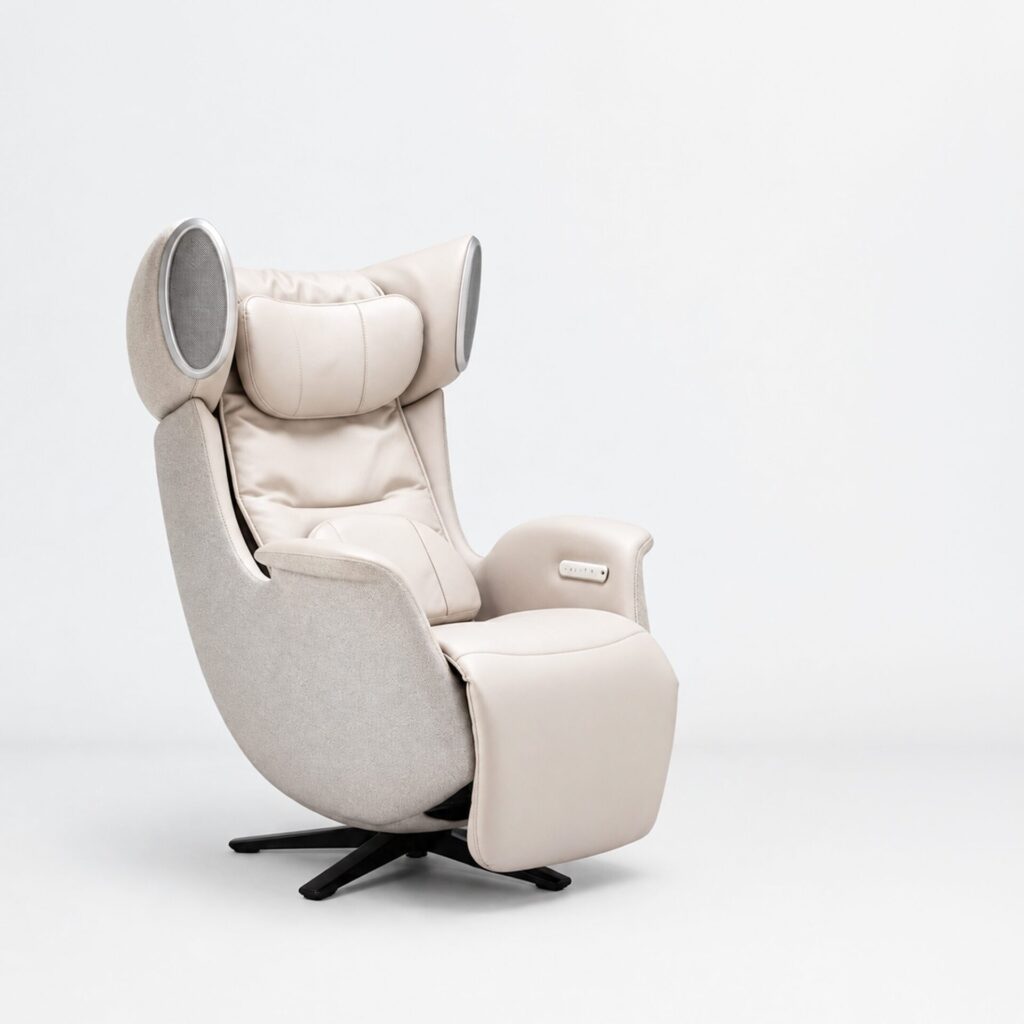
The OGAWA NOVA (AUD 4,500) is the lowest-priced chair of the six. Its page describes an extended SL-Track running from the neck through the lower back and glutes, precision body scanning, zero-gravity recline, lumbar heat and a rocking mode, with Bluetooth audio. It is a furniture-shaped chair first and a machine second — clean stitching, finished surfaces, proportions that suit a living room rather than a gym.
If you’re after gentle, precise massage, start with the OGAWA Vestra (AUD 5,850, Product No. OG6230). It comes equipped with a neck-to-glutes Li-Flex track, 34 airbags, back and calf heat therapy, wave-style foot compression, and a 7-inch touchscreen with side-mounted controls. It reclines to nearly 170°, uses 145 W, and has footprint measurements of 1650 × 760 × 1070 mm upright and 1990 × 790 × 1000 mm reclined, 83.9 kg. It is also suited to buyers who prefer gentle, precise massage over heavy pressure.
AUD 6,000 to AUD 10,000: Lux Master and Meister
This bracket is where the two clearest specialisations in the range sit, and neither is a general-purpose compromise.
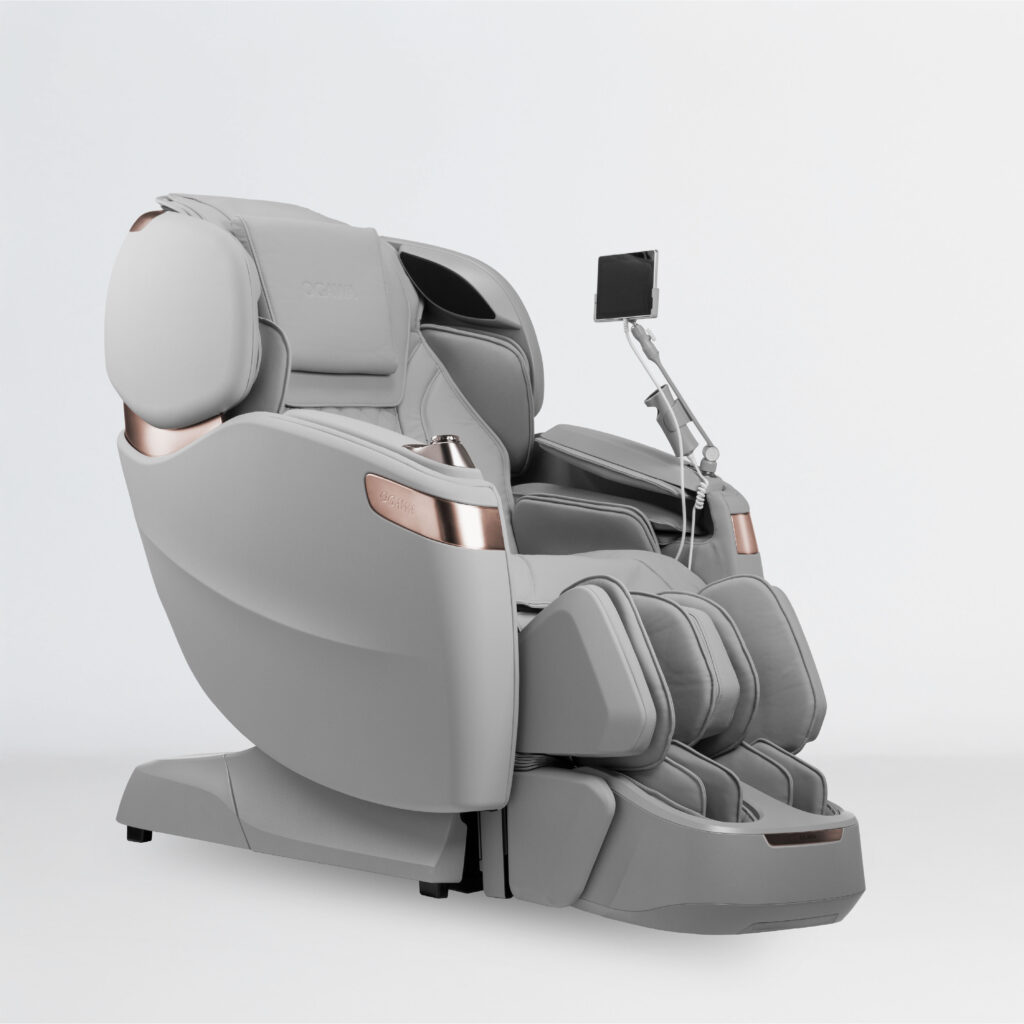
The OGAWA Lux Master (AUD 7,950). It lists 11 inches and two zero-gravity positions, alongside a 3D mechanism with a rotary disc, a Li-Flex track, 34 airbags across shoulder, arm, waist, leg and foot, waist and calf heat, an electric calf lift with kneading and rolling, foot rollers, a 7-inch touchscreen with rotary side control and bilingual voice command, 135 W power, an upright footprint of 158 × 76 × 121 cm, a reclined footprint of 192 × 76 × 98 cm and 84.5 kg.
The OGAWA Meister (AUD 9,950) answers the coverage question. Model OG 7352V. The page publishes a 121.4 cm Flex-Track that flexes to 162° and runs from neck to hips, 4D silicone rollers, 12 techniques, infrared heat in the lumbar and calf areas, voice control in English and Chinese, a 7-inch control panel, a 6th-generation processor with over-the-air updates, 150 W power, an upright footprint of 160 × 78 × 125 cm, a reclined footprint of 202 × 78 × 119 cm, and 111 kg. Of the two chairs in this section, its reclined footprint is the longer — 202 × 78 × 119 cm against 192 × 76 × 98 cm. Across the six, Master Drive AI 3.0 (121.5 kg) and the BIOVIS 5D AI (120 kg) list a heavier figure.
The difference shows up in what each page chooses to list. The Lux Master publishes its lower-body hardware item by item — an electric calf lift with kneading and rolling, foot rollers, and airbags across shoulder, arm, waist, leg and foot — alongside a Li-Flex track that flexes for a near-flat 170° recline. The Meister publishes a single track measurement instead: 121.4 cm of Flex-Track that flexes to 162° and runs from neck to hips, with 4D silicone rollers.
Over AUD 10,000: Master Drive AI 3.0 and BIOVIS 5D AI
Above AUD 10,000 the question changes from “which features” to “what kind of intelligence”, because both chairs are defined by how they sense rather than by how far they travel.
The OGAWA Master Drive AI 3.0 (AUD 15,600) is built around AI body sensing and Smart Trace + CoreSense mapping for acupoint targeting. A Vision Dial handles control, and the Motion Flex foot system adjusts to 135° for full-body and ankle stretch. The same page publishes a 4D intelligent movement, an SL track, 60+ airbags, 25+ automatic programs, 170 W power and 121.5 kg, with an upright footprint of 165.6 × 81.2 × 119.2 cm and a reclined one of 198.2 × 81.2 × 97.2 cm.
The OGAWA BIOVIS 5D AI (AUD 20,860) is the top of the range and the most sensing-heavy description of the six: a 5D AI mechanism, AI Bio-Scanning, real-time adjustment described as responding to posture and muscle tension, a Li-Flex track for full spine coverage, an immersive built-in speaker system and full-body plus ankle stretch. The page also publishes a 12-inch Infinity Pad, 120 kg, 220 W, an upright footprint of 1600 × 807 × 1256 mm and a reclined one of 1890 × 807 × 1025 mm.
Set against each other, these two are closer on geometry than their prices suggest. The Master Drive AI 3.0 measures 165.6 × 81.2 × 119.2 cm upright and 198.2 × 81.2 × 97.2 cm reclined at 121.5 kg, on an SL track with 60+ airbags. The BIOVIS 5D AI measures 1600 × 807 × 1256 mm upright and 1890 × 807 × 1025 mm reclined at 120 kg, on a Li-Flex track, with no airbag count published. The BIOVIS reclines into 9.2 cm less length and is 1.5 kg lighter; their widths differ by 5 mm. What is left is the 5D mechanism and the sensing each page describes, which is the part a showroom visit answers.
Buying facts for Australia
| What to check | What the pages state |
|---|---|
| Warranty | 5-Year Protection Plan: 3 Years Mechanical Warranty (Parts & Labor) + 2 Years Extended Labor Coverage. Years 4–5 cover labour only; parts are quoted separately. |
| Trial and returns | 30 days, direct online purchase only, and not available if you have visited or tried the chair in a showroom. The chair must be clean and undamaged and returned in its original packaging, one return per household. A 20% restocking or depreciation fee may apply, depending on the condition of the returned chair. Original shipping, return shipping, re-packing and handling are the customer’s responsibility. |
| Finance | 0% interest plans up to 36 months with a low establishment fee; credit criteria and provider terms apply. |
| Showrooms | Six, across Sydney, Melbourne, Brisbane, Adelaide and Perth, each with a published address and phone number. |
Two notes on that table. Product listings carry a shorter warranty badge than the policy page, so read the policy. And outside the 30-day window the published return policy is not a change-of-mind refund, which makes the trial window the point to test the chair.
Irelax’s About and Warranty pages describe the company as OGAWA’s exclusive distributor in Australia, and the Australian site runs from AUD 899 for an office massage chair to AUD 20,860 for the BIOVIS, so one retailer can answer this question at a desk-chair budget and at a flagship budget. Both are company-published statements rather than independently reviewed agreements.
Frequently asked questions
What massage chair is recommended in Australia?
The chair this guide would try first is the OGAWA Vestra at AUD 5,850 — a Li-Flex track, 34 airbags, near-170° recline and 83.9 kg at a mid-range price. That pick is an editorial recommendation for buyers who prefer a gentle, precise massage, taken from the positioning on the product page; it is not a ranking of what suits every Australian household. For AI body sensing and acupoint mapping, the OGAWA Master Drive AI 3.0 at AUD 15,600 is the alternative.
Which massage chair is most recommended in Australia?
It depends on the constraint that binds first. On wall clearance, the Lux Master is the only one of the six whose page gives a figure: 11 inches. On track length, the Meister publishes a 121.4 cm Flex-Track flexing to 162°. On price, the NOVA at AUD 4,500 is the cheapest of the six.
How much does a massage chair cost in Australia?
Irelax’s Australian site runs from AUD 899 for an office massage chair to AUD 20,860 for the BIOVIS 5D AI, displayed in November 2026. The six full-size chairs compared here sit between AUD 4,500 and AUD 20,860, and the spread reflects mechanism, track length, airbag count and build weight rather than brand prestige.
How much space does a massage chair need?
Ask for the reclined footprint rather than the upright one, and ask for both, because the reclined footprint is 34 to 42 cm longer than the upright one on these chairs. The Lux Master publishes 158 × 76 × 121 cm upright and 192 × 76 × 98 cm reclined, the Meister 160 × 78 × 125 cm and 202 × 78 × 119 cm, and the Vestra 1650 × 760 × 1070 mm upright against 1990 × 790 × 1000 mm reclined. Measure doorways, lifts and stair turns against the reclined length, and confirm the packaged dimensions, which parts can be removed for carrying and any minimum aisle width before the delivery is booked — the product pages do not publish those.
Can I try a massage chair before buying in Australia?
Yes — the site lists showrooms and invites shoppers to book a free trial. Confirm the branch, its hours and which models are on the floor before travelling. Note that the 30-day online trial does not apply if you have already visited or tried a chair in a showroom.
Are massage chairs medical equipment?
No. Irelax’s Warranty page states that massage products are not medical equipment, and it advises customers with a specified medical condition to follow their doctor’s advice. The features described here relate to comfort and relaxation during use.
How this list was put together
The order is a retail recommendation, not an independent ranking, and it is built from what each product page publishes rather than from laboratory testing. Five things decided it: floor and wall clearance, how many people in the household will use the chair and at what height, the pressure the mechanism is described for, how far the track travels, and how the controls work for daily use.
A chair that suits a 190 cm user in a Queensland living room is not automatically right for a 155 cm user in a Melbourne apartment, which is why the models above are grouped by constraint and budget rather than ranked 1 to 6. Where two chairs in a bracket look similar on paper, compare the published specifications line by line, then try both on the same program.