

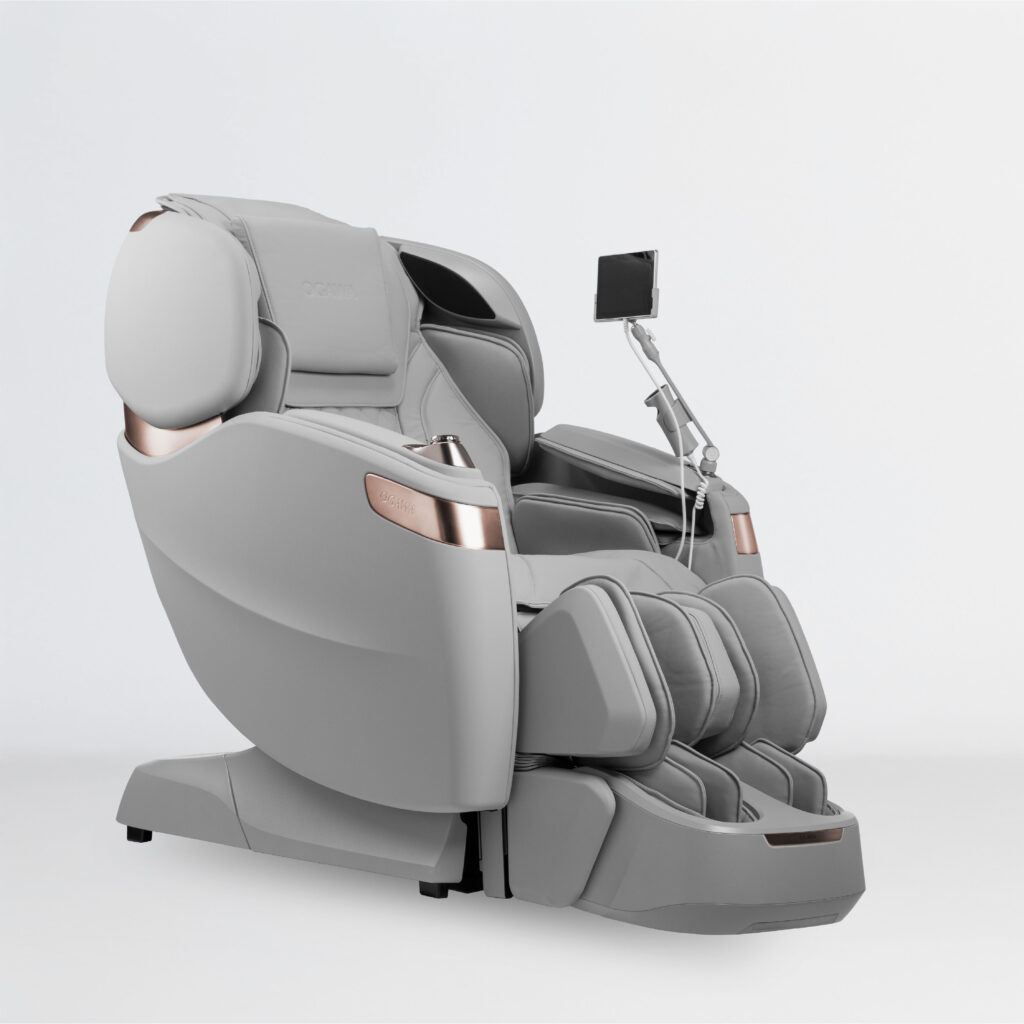






Massage Chair
2D vs 3D vs 4D Massage Chair Technology: Observed Differences in Mechanism and Experience

The classification of massage chairs into 2D, 3D, and 4D systems appears frequently in product descriptions and technical documentation. The terms describe differences in roller movement rather than separate categories of devices. Each stage reflects an additional layer of mechanical capability built onto a shared base structure.
In most cases, these distinctions are presented as dimensional labels. However, the underlying structure remains centered on the same principle: rollers move along a fixed track to simulate manual massage patterns. The variation lies in how many directions and how much control the system can apply during operation.
Across the category, differences are not always absolute. Some manufacturers interpret these terms differently, which creates overlap in features across models.
2D Massage Systems and Basic Movement Structure
The 2D massage chair is considered to be the basic setting in the massage chair category. The operation is performed using two major axes.
They are:
- Vertical movement on the spine
- Horizontal movement on the back
This setting allows rollers to move upwards and downwards while moving sideways. The movement is done at a surface level, with depth limited to an unchanging dimension set by the inner frame.
Characteristics of the 2D setting:
- Continuous pressure of rollers without changing the depth
- Same speed of movement throughout the duration of the massage
- Coverage of large muscles as opposed to intensiveness of the treatment
- Simplistic mechanism with fewer movable parts
The stability of the mechanism is assured since there are no changes in pressure depth.
3D Massage Systems and Depth Variation
With the introduction of 3D systems, an extra axis is introduced for mobility. The benefit of the extra axis is that the rollers can move forward and backward, leading to various levels of pressure distribution.
Key modifications made by 3D system include:
- Movement of rollers both forward and backward
- Ability to adjust the depth of rollers during use
- Different levels of pressure applied to different parts of the back
The new mechanism changes the process of pressure application. The new system provides the flexibility to vary application depth based on the programmed setting.
Effects noticed with 3D system include:
- Enhanced access to deeper muscles
- Variation in the level of pressure application from session to session
- Distinct difference in the effect experienced by different setting ranges
- Greater awareness regarding the body posture and shape
The 3D mechanism can be regarded as the advanced version of the 2D framework.
4D Massage Systems and Temporal Variation
4D systems extend the 3D structure by introducing variation in speed and rhythm. This does not change the physical axes of movement but alters timing patterns during operation.
Core additions include:
- Variable roller speed during a single session
- Dynamic rhythm changes across massage cycles
- Adjustments that simulate manual massage pacing
- Improved programming to simulate human massage techniques
These changes affect how the massage feels rather than where it is applied. 4D massage systems are an extension of 3D technology. They retain all 3D capabilities while introducing more advanced control over movement behavior
Commonly observed features include:
- Alternating slow and fast motion phases
- Shifts in pressure timing without manual input
- More varied sequence patterns across programs
- Increased complexity in preset routines
- Pressure curve adjustments
The 4D classification therefore refers to time-based modulation rather than a new physical direction of motion.
Dimensional Comparison in Functional Terms
Across 2D, 3D, and 4D systems, the differences can be grouped into three functional layers rather than separate machines.
- Movement Range
- 2D: Vertical and horizontal
- 3D: Adds depth extension
- 4D: Retains depth with speed variation
- Pressure Control
- 2D: Fixed pressure level
- 3D: Adjustable intensity
- 4D: Variable pressure timing
- Experience Structure
- 2D: Uniform and predictable
- 3D: Adjustable and targeted
- 4D: Dynamic and rhythm-based
These layers build on each other rather than replacing earlier functions.
Observed Design and Manufacturing Variation
Manufacturing practices introduce variation across models labeled under the same dimensional category.
Common patterns include:
- Shared mechanical frames across multiple product lines
- Different interpretations of “3D” and “4D” across manufacturers
- Overlapping features between upper-tier 3D and entry-level 4D systems
In practice, classification depends on implementation rather than strict technical boundaries.
Observed manufacturing tendencies:
- Component reuse across different models
- Software-based differentiation between tiers
- Incremental upgrades rather than full redesigns
- Regional variation in model naming conventions
These factors contribute to inconsistency in how dimensions are represented in retail environments.
User Interaction Patterns Across Systems
Interaction with massage chairs varies by system complexity. The number of available settings does not always correspond to actual usage patterns.
Common behavioral observations include:
- Preference for preset programs over manual control
- Limited adjustment of depth or speed settings after initial use
- Short sessions rather than full program cycles
- Repeated use of specific comfort zones
Across all three systems, interaction often stabilizes after initial experimentation.
Typical usage tendencies:
- 2D systems: consistent, single-mode use
- 3D systems: selective intensity adjustment
- 4D systems: preset-based dynamic programs
The difference lies more in available options than in sustained user behavior.
Environmental Context and Operational Conditions
The environment in which a massage chair operates influences how its features are experienced.
In residential settings:
- Usage remains flexible
- Settings are adjusted frequently
- Sessions are interrupted based on comfort
In commercial or shared environments:
- Predefined programs dominate
- Limited customization is available
- Usage follows fixed time cycles
These conditions affect perception of system capability without changing the mechanical structure itself.
Conclusion
2D, 3D, and 4D massage systems represent incremental changes in roller movement, depth control, and timing variation. Each level builds on a shared mechanical foundation rather than introducing entirely separate technologies.
Across the category, differences appear most clearly in how pressure is delivered and how motion is varied over time. However, implementation varies across manufacturers, which creates overlap between categories.
Further technical details, model configurations, and product variations can be explored through the irelax website. You can find additional information in the blog and product sections for deeper category-level reference.
The result is a system defined less by fixed technical boundaries and more by degrees of mechanical and programmed variation.
FAQ Section
- Is 3D simply a refinement of 2D?
The 3D system incorporates depth adjustment into the existing 2D system without discarding its base.
- What is the advantage of a 4D massage chair?
The 4D massage chair adds varying speed and rhythm to the operation of massage rollers.
- Are definitions of 3D and 4D consistent among massage brands?
No. Different manufacturers have their own interpretations of both dimensions. In some cases, users found that entry-level 4D models felt similar to high-end Irelax 3D chairs, highlighting the role of implementation rather than classification. The level of technology used by the manufacturer plays a significant role in determining the overall comfort of a massage chair.
- Is a 4D massage chair physically different from the 3D massage chair?
A 4D massage chair is not fundamentally different in physical structure from a 3D massage chair, but it often includes enhanced control systems and, in some cases, upgraded components.
- Is more dimension equal to a more intensive massage?
It is not true. Massage intensity depends on the massage rollers themselves.