

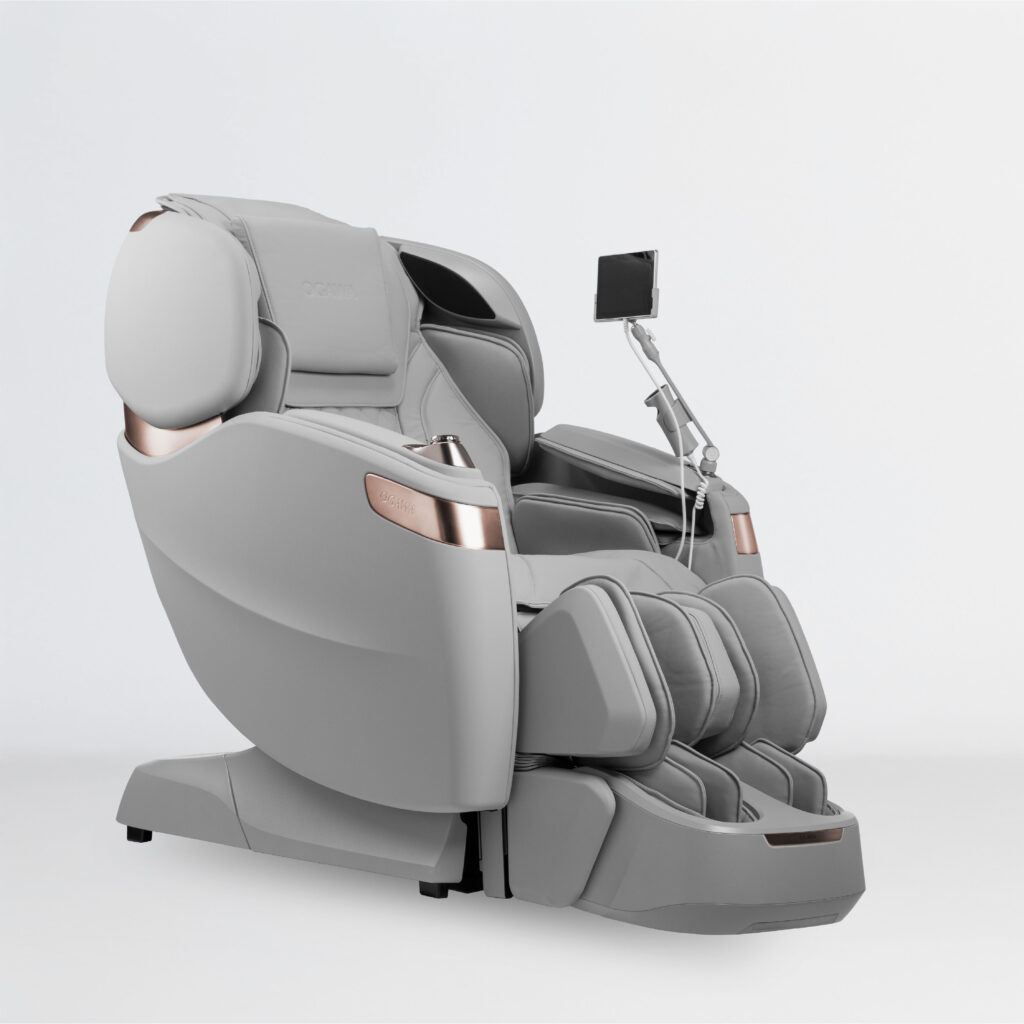






Massage Chair
Can You Use a Massage Chair During Pregnancy?

The use of massage chairs during pregnancy appears as a recurring point of discussion across both consumer and clinical contexts. The question does not produce a single, stable answer. Instead, it reflects a mix of precaution, mechanical understanding, and variation in individual response.
Massage chairs operate through pressure, motion, and optional heat. Under normal conditions, these functions remain routine. During pregnancy, the same features are viewed with more attention. The focus shifts from general comfort to how external stimulation interacts with a body undergoing change.
Across available references, the discussion rarely centers on confirmed harm. It tends to remain within areas where certainty is limited. This creates a pattern where caution appears even when direct evidence remains minimal.
Mechanical Interaction During Pregnancy
Massage chairs depend on mechanical systems that stimulate the body systematically. This is an unchanging system that doesn’t adjust to biological changes automatically. It operates based on predefined mechanical cycles.
There are three primary operations used in most massage chairs:
- Rollers that slide across the spine and back
- Air pumps surrounding the legs and arms
- Vibrators and optional heaters
These actions all occur externally. The massage chair does not exert pressure internally or on the abdomen.
However, when a woman becomes pregnant, her perception of these stimulations can change because of:
- Enhanced sensitivity in muscles and joints
- Posture and spinal column changes
- Differences in blood flow and water retention
As a result, the same mechanical stimulus will have a different effect during pregnancy than before it.
Recurring Areas of Concern
Discussion around massage chair use tends to repeat a small number of concerns. These appear consistently across articles and user queries.
The most common include:
- Vibration Exposure
- Often linked to concerns about fetal impact
- In practice, vibration remains surface-level and localized
- It does not function as deep internal transmission
- Pressure Points
- Associated with the idea of triggering contractions
- Massage chairs do not deliver sustained, targeted pressure
- Pressure remains distributed rather than focused
- Heat Application
- The most frequently referenced concern
- Related to overall body temperature rather than the chair itself
- Heat functions are often adjusted or avoided in practice
These concerns persist because they connect to broader pregnancy precautions, not necessarily because of chair-specific evidence.
Differences Between Medical and Manufacturer Positions
There is an evident discrepancy regarding how medical literature and manufacturers define the use of a massage chair.
In medical literature, the subject is approached from an observational perspective:
- Usage is considered to be appropriate in moderate settings.
- There is no documented proof of any harm being caused directly.
- There is an emphasis on personal reaction.
Manufacturers adopt an alternative approach:
- Warnings are always provided.
- Pregnant women are advised against use without proper approval.
- The language used depicts a liability-based approach instead of direct evaluation.
These result in two contrasting interpretations:
- One that focuses on observed results.
- One that emphasizes avoiding risks.
This disparity is not reconciled with any definitive answer but forms part of the larger ambiguity surrounding the matter.
Stage-Based Variation in Response
Pregnancy introduces changes that evolve over time. Each stage may influence how massage chair use is experienced.
Typical variation appears as follows:
- First trimester
- Higher level of general caution
- Many activities are limited due to uncertainty
- Decisions often lean toward avoidance
- Second trimester
- Physical adaptation begins to stabilize
- Comfort levels may improve in some cases
- Response to pressure remains variable
- Third trimester
- Increased body weight and posture changes
- Greater sensitivity in lower back and legs
- Pressure may feel stronger even at lower settings
These patterns are not fixed rules. They reflect tendencies observed across different individuals rather than a consistent outcome.
Observed Usage Patterns
Where massage chairs are used during pregnancy, interaction tends to follow certain adjustments. These are not formal guidelines, but repeated behaviors.
Common usage patterns include:
- Selection of lower intensity settings
- Shorter session durations
- Avoidance or reduction of heat functions
- Preference for gentle or preset programs
In addition, some users:
- Stop sessions earlier if discomfort appears
- Avoid full-body programs
- Focus on limited areas such as upper back
These patterns show that interaction becomes selective rather than complete.
For example: A customer in her second trimester chose to use the massage chair only on low intensity settings, focusing on the upper back. She avoided heat functions, avoided to massage her back and lower back, and limited sessions to 10–15 minutes. Over time, usage became occasional rather than routine.
Environmental and Contextual Factors
The setting in which a massage chair is used also affects behavior.
In residential environments:
- Users have full control over settings
- Sessions can be stopped at any time
- Adjustment occurs based on immediate comfort
In shared or commercial environments:
- Preset programs dominate usage
- Session duration may be fixed
- Control over intensity may be limited
This difference does not change the chair itself. It changes how much flexibility exists during use.
Broader Context of Precaution
Massage chair use during pregnancy sits within a wider pattern of precaution. Many routine activities are reconsidered during this period.
This includes:
- Physical exercise
- Postural habits
- External therapies
In this context, massage chairs are not evaluated in isolation. They are considered alongside other forms of physical interaction.
The focus remains on reducing uncertainty rather than responding to confirmed outcomes.
Conclusion
Massage chairs during pregnancy represent a case where mechanical systems meet biological variation. The devices operate within defined limits, but their interaction with the body does not follow a single pattern.
Across available material, the discussion remains shaped by caution. Differences in guidance, usage, and perception prevent a unified position.
The result is a use case defined more by context and individual response than by the device itself.
Further details on massage chair models, configurations, and structural differences can be reviewed through the irelax website. Additional information remains available across product listings and related materials for those examining the category in more detail.
FAQ Section
- Is there confirmed evidence that massage chairs are unsafe during pregnancy?
No consistent evidence confirms direct harm when used under moderate conditions. - Why do manufacturers include warnings?
Warnings reflect precaution and liability rather than confirmed risk. - Do massage chairs affect the abdomen?
Standard designs focus on the back and limbs, not the abdomen. - Why is heat discussed more than other features?
Heat relates to overall body temperature, which is monitored more closely during pregnancy. - Does everyone respond the same way?
No. Comfort and sensitivity vary across individuals and stages.